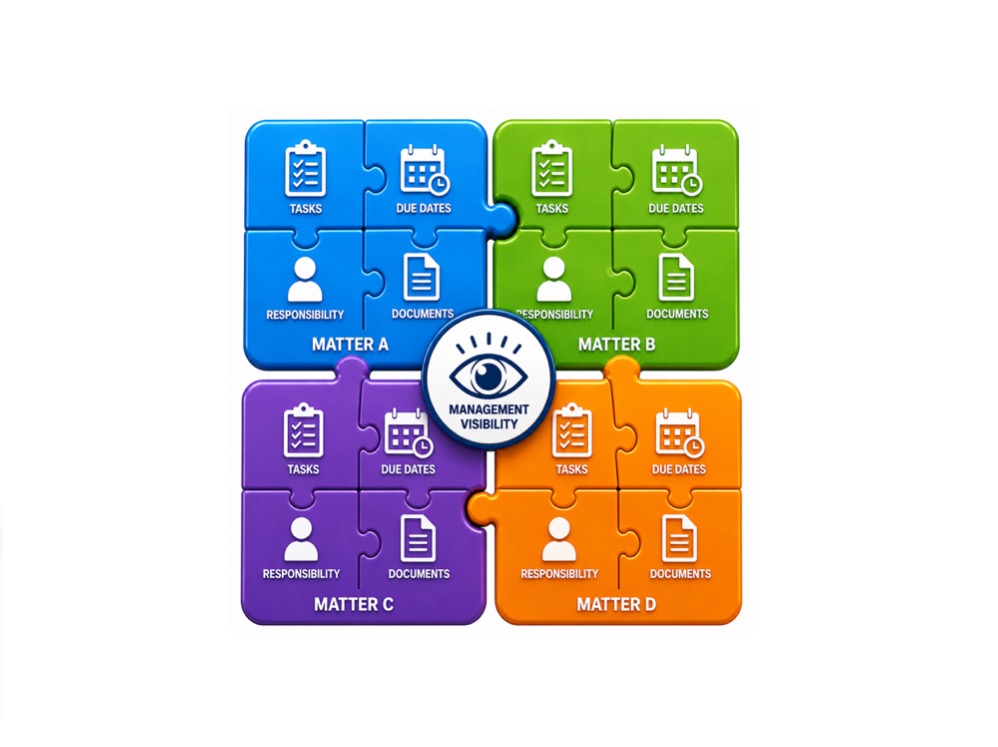
When people talk about improving visibility in a Trust & Estate organization, they can mean several different things.
At the individual matter level, visibility might mean being able to find the information you need.
It might mean understanding where a matter stands and what needs to happen next.
At the organizational level, it means being able to see across all of those matters to understand the operation as a whole.
These are 3 distinct – but interconnected – levels of visibility.
1. Matter Information — What do we know?
Every Trust & Estate matter generates a substantial amount of information:
• Who are the relevant contacts?
• Who is fulfilling the key roles?
• What are the dates of record?
That data necessarily exists somewhere, but how accessible is it?
Good matter-information visibility means:
• The information is brought together in one place
• That information is reliably updated
• Everyone who needs the information has access to it
2. Matter Progress — Where are we?
Having all of the matter information readily available still doesn't necessarily tell you where the matter stands.
Understanding progress requires both a view backwards (what has happened) and a view forwards (what lies ahead).
The history of a matter generally exists somewhere: Documents created, filings made and emails exchanged.
But that history may be spread across different places, and it may not provide a clear or consistent picture of the progress to date.
The future is different.
For the path ahead to be visible, it needs to have been documented — at least in broad terms:
• What are the major steps still to come?
• What needs to happen next?
• What deadlines need to be met?
• Who is responsible?
So good matter-progress visibility requires both sides of the picture:
• A readily accessible history of what has happened
• A documented, readily accessible view of what happens next
3. Organization-Level Visibility — What's our exposure across all matters?
The third level moves beyond the individual matter.
Even if an organization has excellent visibility into the information and progress of each individual matter, management has a different need: understanding what is happening across the operation as a whole.
• Which matters need attention?
• Where is work falling behind?
• How is work distributed across people and teams?
• What is the firm's exposure to key filing liabilities?
To answer questions like these, the organization needs to be able to bring together information from across all of its matters.
But creating that organization-level view presents some challenges:
• The same information needs to be captured consistently from matter to matter
• Progress needs to be tracked consistently across different people and teams
• Similar activities need to be described and managed in consistent ways
Bringing the Three Levels Together
The three levels are different, but they build on one another.
At each level, the value of visibility comes from making information consistent, reliable and readily accessible to the people who need it.
When that happens:
• Less time is spent searching for information or asking others for status
• The current status of an individual matter is easier to grasp
• Work can move more easily between people and teams
• An accurate organization-wide view is readily available
The result is not simply more information. It is greater confidence in what is happening — at the matter level and across the organization as a whole.
EstateWorks brings matter information, progress and organization-level visibility together in one operational platform built specifically for Trust & Estate work.
Contact us to see how EstateWorks can improve visibility across your operation.
Schedule a Demo