Checklists are among the most valuable operational tools used by Trust and
Estate organizations.
They establish consistency, reduce the risk of missed activities and provide
confidence that matters are progressing as expected.
The challenge is that a checklist, by itself, is not an operating model.
A checklist records what needs to happen on a matter. An operating model determines how the organization consistently delivers it.
The best checklists reflect the operating model. They don't define it.
A checklist should reinforce how the organization operates-not become a substitute for it.
When the operating model is well designed, checklists become a natural expression of that design rather than simply a list of activities to complete.
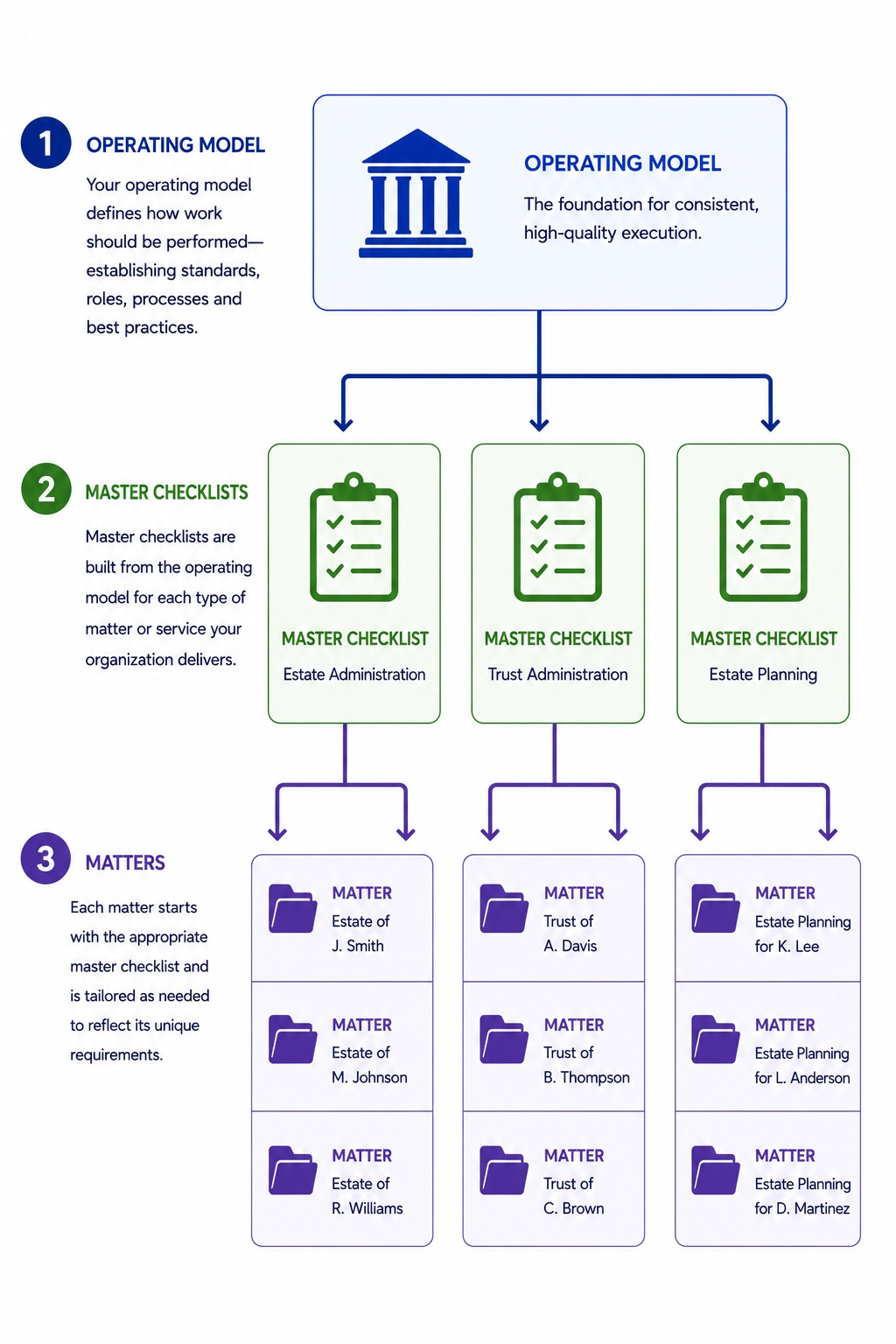
Every Checklist Should Start With a Master
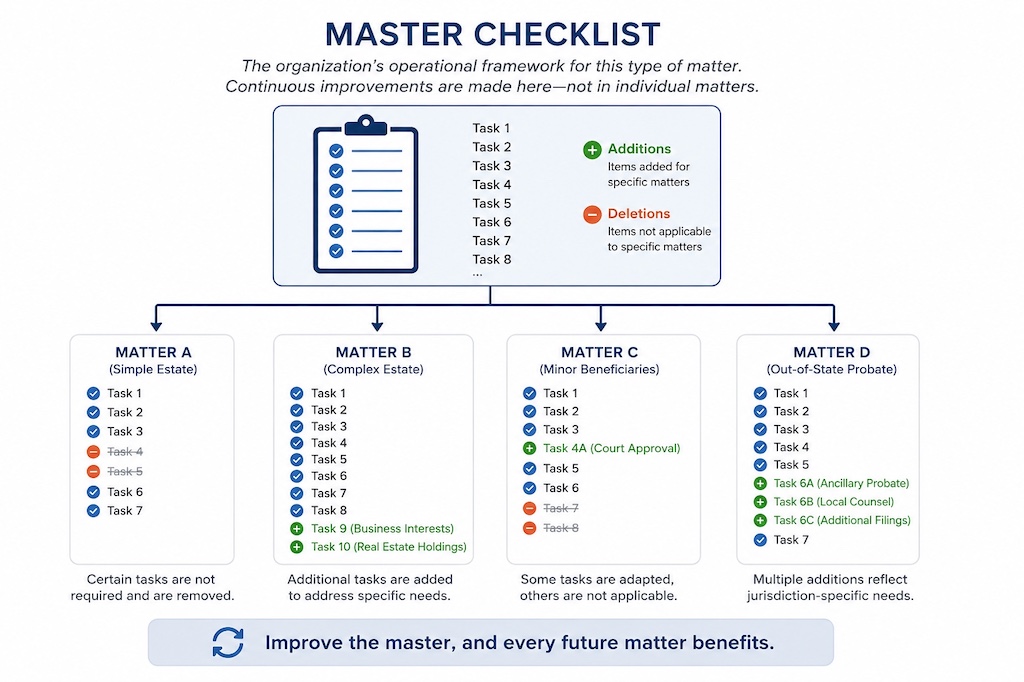
The objective is not to create a new checklist for every matter.
It is to create a master checklist that captures how the organization intends
to operate for each type of matter.
Each new matter should begin with that operational framework and then be
adapted to reflect its specific circumstances.
Institutionalize best practices once. Adapt them for every matter.
Every improvement should be made to the master checklist, not to individual matters.
Over time, the master checklist becomes more than a template. It becomes a practical expression of the organization's operating model, with every new matter benefiting from the experience gained on those that came before.
Planning & Settlement Require Different Checklist Architectures
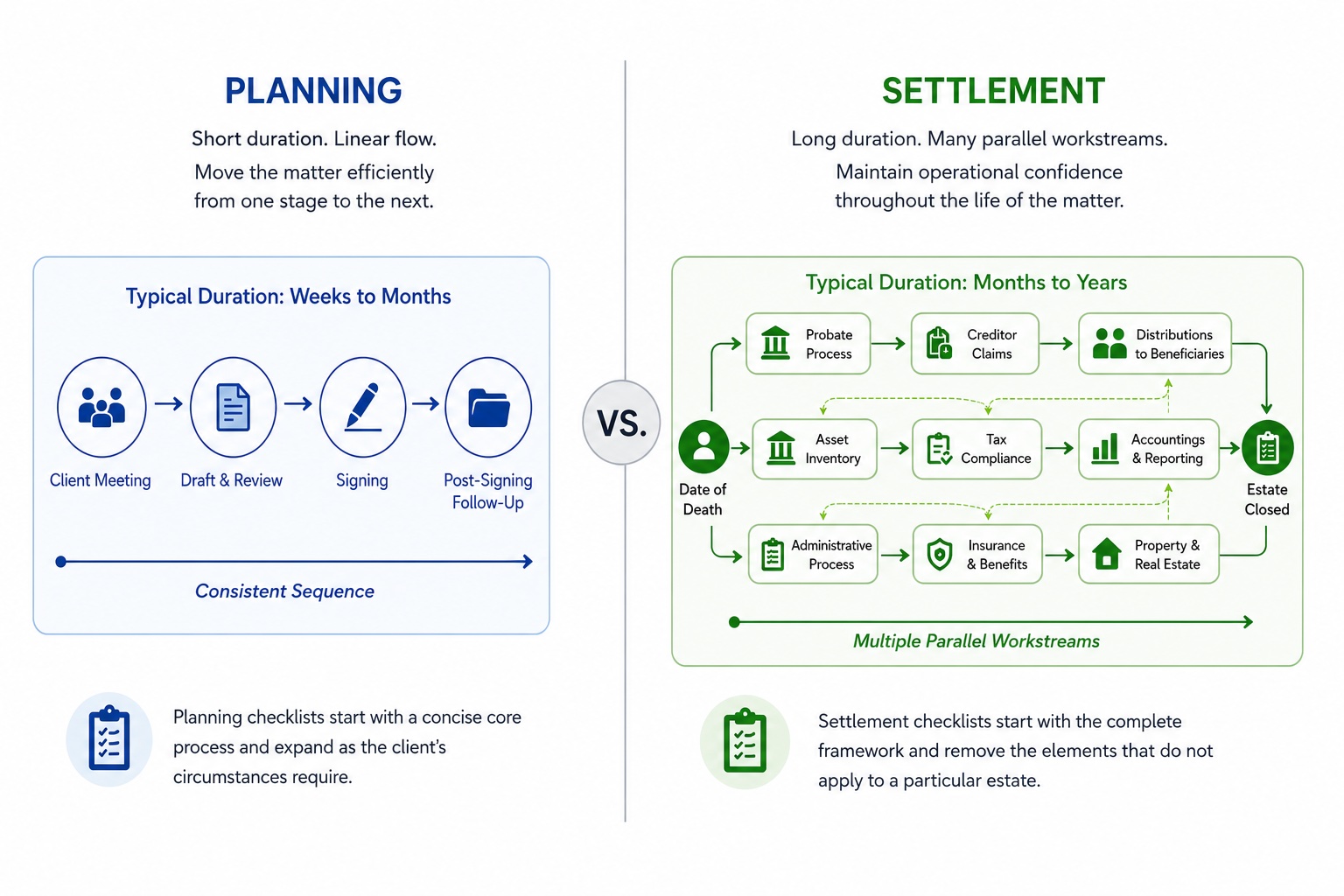
Although Estate Planning and Estate Settlement share many operational principles, they place very different demands on the organization.
Planning matters are generally short in duration and follow a relatively consistent sequence of activities. The objective is to move each matter efficiently from one stage to the next while maintaining a consistent client experience.
Settlement matters are fundamentally different. They often continue for
many months or even years, involve multiple parallel workstreams and
contain numerous externally driven deadlines. The objective is not simply to
complete tasks, but to maintain operational confidence throughout the life
of the matter.
The checklist architecture should reflect those different priorities.
Planning checklists generally begin with a concise core process that expands as the client's circumstances require.
Settlement checklists usually take the opposite approach: start with the complete operational framework and remove the elements that do not apply to a particular estate.
 In both cases, the objective is the same:
Create a consistent operational framework that can be adapted to the needs of each matter without redesigning the process from scratch.
In both cases, the objective is the same:
Create a consistent operational framework that can be adapted to the needs of each matter without redesigning the process from scratch.
Every Operational Checklist Has Four Components
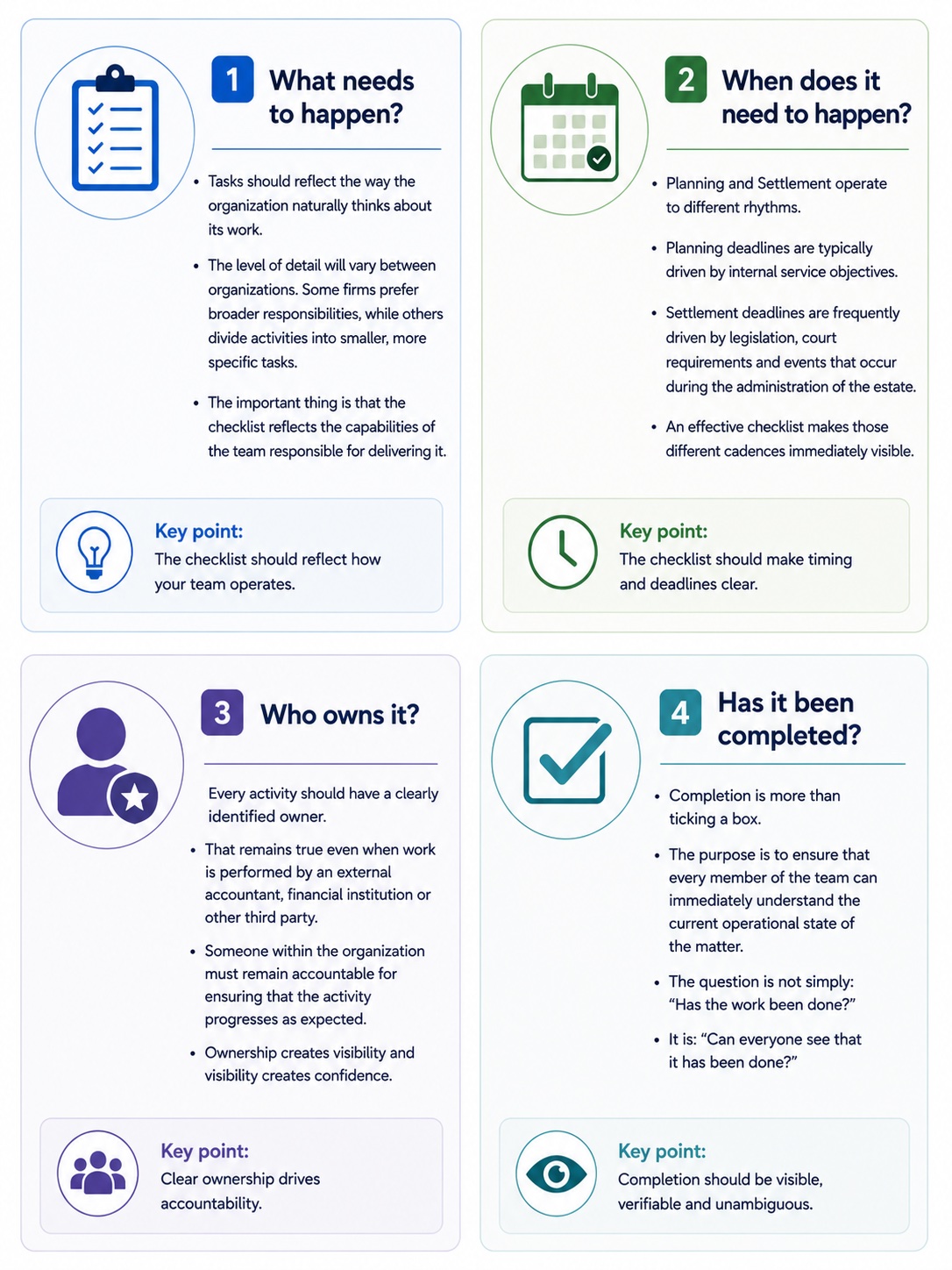
Regardless of the type of work, every operational checklist answers four fundamental questions:
1) What needs to happen?
Tasks should reflect the way the organization naturally thinks about its work.
The level of detail will vary between organizations. Some firms prefer broader responsibilities, while others divide activities into smaller, more specific tasks.
Neither approach is inherently right or wrong.
The important thing is that the checklist reflects the capabilities of the team responsible for delivering it.
2) When does it need to happen?
Planning and Settlement operate to different rhythms.
Planning deadlines are typically driven by internal service objectives.
Settlement deadlines are frequently driven by legislation, court requirements and events that occur during the administration of the estate.
An effective checklist makes those different cadences immediately visible.
3) Who owns it?
Every activity should have a clearly identified owner.
That remains true even when work is performed by an external accountant, financial institution or other third party.
Someone within the organization must remain accountable for ensuring that the activity progresses as expected.
Ownership creates visibility and visibility creates confidence.
4) Has it been completed?
Complete is more than ticking a box.
The purpose is to ensure that every member of the team can immediately understand the current operational state of the matter.
The question is not simply: "Has the work been done?"
It is: "Can everyone see that it has been done?"
Characteristics of an Effective Operational Checklist
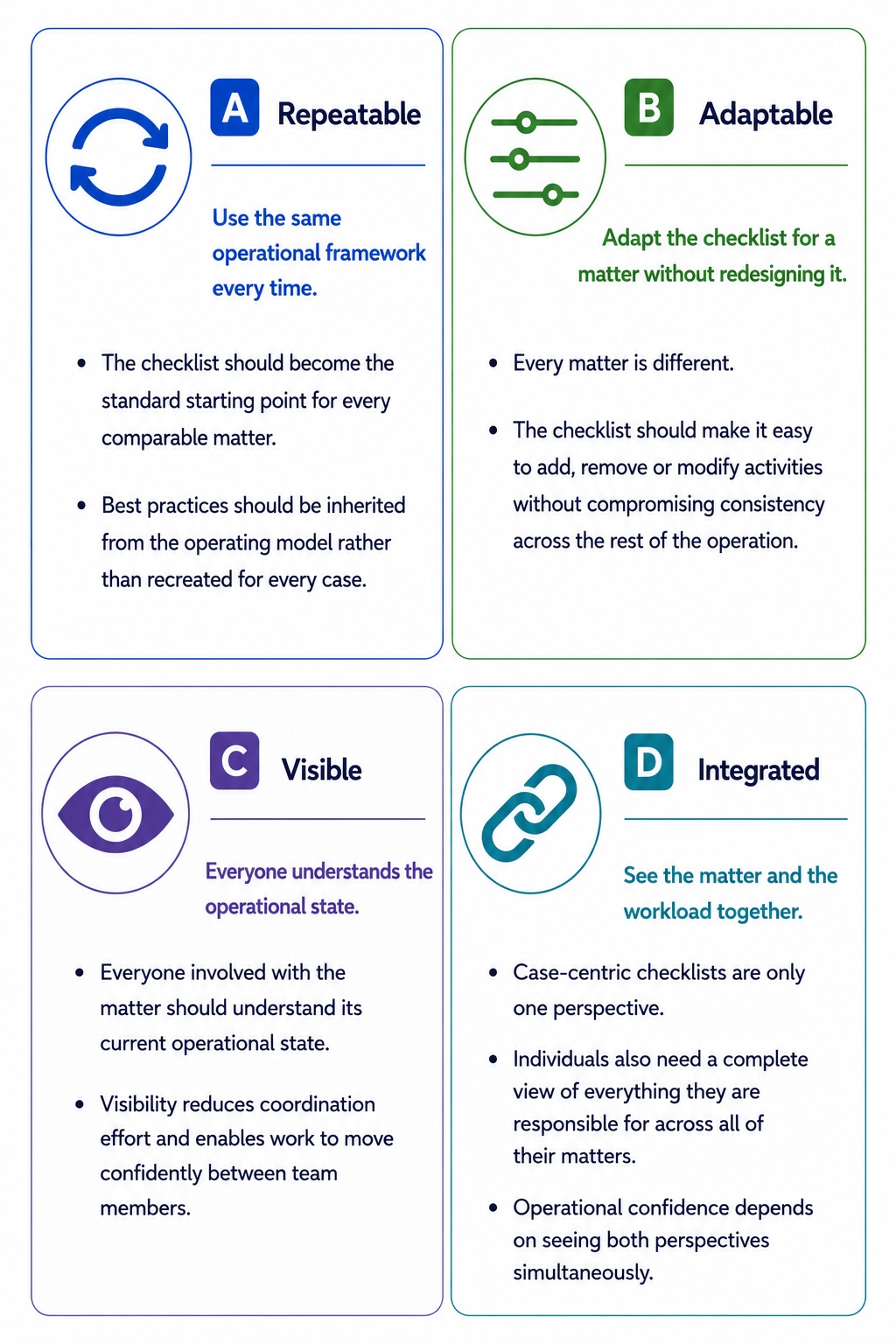
Well-designed checklists share four common characteristics.
A. Repeatable - Use the same operational framework every time.
The checklist should become the standard starting point for every comparable matter.
Best practices should be inherited from the operating model rather than recreated for every case.
B. Adaptable - Adapt the checklist for a matter without redesigning it.
Every matter is different.
The checklist should make it easy to add, remove or modify activities without compromising consistency across the rest of the operation.
C. Visible - Everyone understands the operational state.
Everyone involved with the matter should understand its current operational state.
Visibility reduces coordination effort and enables work to move confidently between team members.
D. Integrated - See the matter and the workload together.
Case-centric checklists are only one perspective.
Individuals also need a complete view of everything they are responsible for
across all of their matters.
Operational confidence depends on seeing both perspectives
simultaneously.
Operational Confidence Begins With Operational Design
A checklist should do far more than record activities.
It should reinforce how the organization intends to operate.
When designed well, checklists help institutionalize best practices, improve
operational visibility and reduce dependence on individual coordination.
The checklist becomes part of the operating model—not merely a record
of it.
 EstateWorks provides an operational platform that helps Trust and Estate
organizations build operational confidence into the way they work while
preserving the professional judgement that clients value.
EstateWorks provides an operational platform that helps Trust and Estate
organizations build operational confidence into the way they work while
preserving the professional judgement that clients value.
Schedule a Demo
More Trust and Estates Workflow Resources
Other resources that you may find useful.
Browse All Resources