Growth doesn't just create more work.
It creates more people to coordinate, more matters to oversee, more handoffs to manage and more opportunities for different teams to develop different ways of working.
When an operation is relatively small, much of that complexity can be managed through individual knowledge and informal coordination. People know who does what. They know where to find information. Experienced team members know what needs to happen next.
As the operation grows, those informal mechanisms become harder to sustain.
The challenge is not simply handling more work. It is creating an operation that can handle more work without becoming increasingly dependent on individual knowledge and manual coordination.
That requires an operational foundation that can grow with you.
When Growth Changes the Problem
The pressure can appear in different ways.
Perhaps a solo practitioner has added several people and can no longer personally oversee every matter.
An established practice may be adding another office or team, making it harder to ensure that work is being performed consistently across locations.
Or an organization may have developed its own approach to Trust & Estate work but outgrown the generic tools, spreadsheets and individual systems it has been using to support it.
These situations look different, but the underlying challenge is similar.
As the organization grows, the way work is managed needs to become more scalable.
Three capabilities become particularly important.
1. Standardized Processes
Growth is difficult to manage when everyone has their own way of getting the work done.
That doesn't mean every matter should be identical. Trust & Estate work inevitably requires professional judgment and needs to accommodate different matter types, jurisdictions, clients and circumstances.
But the repeatable parts of the work should not have to be reinvented each time.
A scalable operation needs common processes that establish how work should normally be performed: what needs to happen, when it should happen, who is responsible and what information needs to be maintained.
Those processes provide a common starting point.
They make it easier to bring new people into the organization, hand work between team members and apply the organization's preferred way of working consistently as the operation grows.
2. Configurability
Standardization cannot mean rigidity.
As an organization grows, its requirements will change. It may add new people, offices, matter types or jurisdictions. Responsibilities may shift. Processes may improve. New requirements may emerge.
The system supporting the operation therefore needs to evolve without requiring the organization to start again every time something changes.
That means being able to adapt processes, roles, responsibilities and other operational requirements while preserving the underlying structure that makes consistency possible.
The objective is a balance:
Enough standardization to create consistency. Enough flexibility to adapt as the organization changes.
Without that balance, organizations tend to end up at one of two extremes: processes that are so loose they cannot be applied consistently, or systems that are so rigid people work around them.
Neither scales well.
3. Operational Visibility
Growth also changes what people need to be able to see.
When a practice is small, an experienced attorney or manager may be able to keep a good sense of what is happening simply through day-to-day involvement.
That becomes increasingly difficult as the number of matters, people and teams increases.
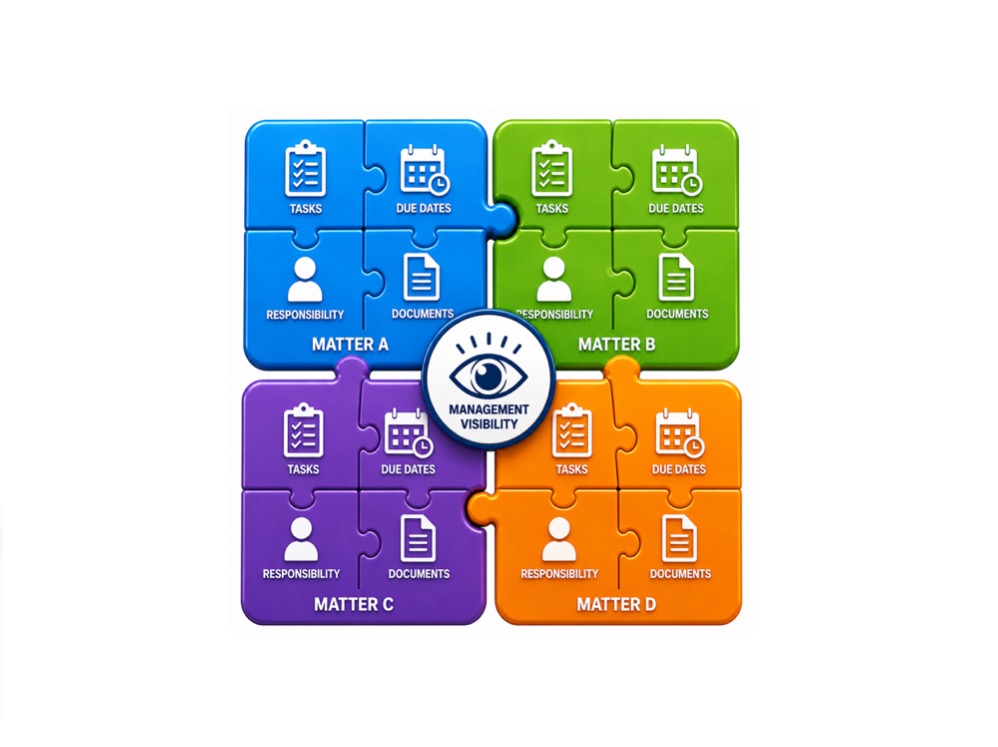
Individuals need visibility into the work they are responsible for. Teams need to understand the status and progress of individual matters. And management needs to understand what is happening across the operation.
That visibility should not depend on repeatedly asking people for updates or requiring them to maintain separate tracking spreadsheets and status reports.
The information needed to understand the operation should be created naturally through the work itself and available to the people who need it.
That makes visibility scalable along with the operation.
Building an Operation That Can Grow
The systems and practices that work for a small Trust & Estate operation are not necessarily the ones that will support a larger one.
As the organization grows, informal knowledge needs to become more explicit. Individual ways of working need to become more coordinated. And management needs visibility that does not depend on personally knowing what is happening in every matter.
The goal is not to add process simply because the organization is getting bigger.
It is to create an operational foundation that allows growth without a corresponding increase in inconsistency, coordination effort and management burden.
That means establishing repeatable processes, retaining the flexibility to evolve them, and making the work visible as it happens.
Growth creates complexity. Your operating environment should help you manage it — not add to it.
Is your Trust & Estate operation outgrowing the way you manage work today? See how EstateWorks can help you grow with greater visibility and consistency.
Schedule a Demo