In the broad field of workflow management, there's often confusion about the relationship between checklists and automation. They're sometimes treated as interchangeable, or automation is assumed to be a necessary characteristic of sophisticated checklist management.
Both have important roles, but neither defines workflow management.
Automation uses technology to perform activities or trigger actions that would otherwise require human intervention. Checklists identify the activities that need to be addressed and provide a structured way to organize, assign, schedule and track them.
For Trust & Estate organizations, checklists can be a practical expression of the operating model: how the organization has decided to organize and deliver particular types of work.
A checklist is primarily concerned with what needs to be done, rather than how each activity is performed. That work may be carried out by professionals, conventional software automation or AI agents, all operating within the same organizational framework.
So, when evaluating software for checklist and workflow management, what should a Trust & Estate organization look for?
There are two broad categories of capabilities to consider:
- Organizational Standards — How effectively can the software capture, maintain and apply the organization’s standard approach to different types of work?
- Managing Real-World Matters — How effectively can those standards be used and adapted to the circumstances of individual matters?
Both matter. Detailed organizational standards are of limited value if they cannot be applied practically to individual matters; flexibility without common standards can undermine consistency.
1. Organizational Standards
An organization should be able to establish its preferred way of handling different types of work, capture that approach in standard checklists and maintain those standards as its requirements evolve.
Coverage
A typical Trust & Estate practice handles both estate settlement and estate planning. Settlement may require different checklists depending on jurisdiction or complexity. Other work may include trust administration, entity creation or real estate transactions.
The checklist management system should accommodate this variety without requiring different checklist tools for different types of work.
Checklist coverage should also be distinguished from jurisdiction-specific forms support. A system may support the creation and management of checklists for work in many jurisdictions while offering curated forms or automated form preparation for only a subset of them. These are separate capabilities and should be evaluated separately.
Integration
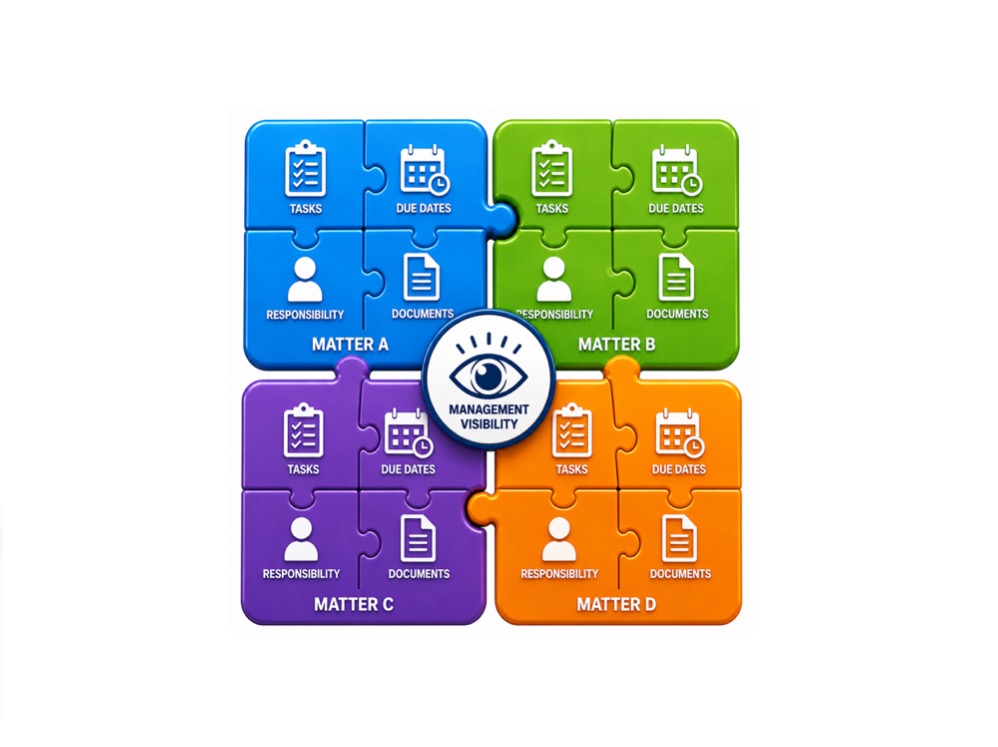
Checklists are only one part of an effective Trust & Estate operating system, which also manages matters, contacts, responsibilities, dates, financial information and documents.
Checklist management should be integrated with that broader system rather than operating as an isolated application. This helps avoid duplicate information and allows checklist activity to contribute to matter transparency and management visibility.
Checklist Definition
Trust & Estate work lends itself to predefined processes containing specific tasks that reflect the organization's choice in how the work should be organized.
Estate settlement might be divided into administration, probate, financial and tax-related processes. Estate planning might use pre-signing and post-signing processes, while other activities may require specialized processes such as Crummey notices.
The system needs to accommodate these different structures and allow the organization to create new checklists or modify existing ones as its needs evolve.
Default Task Allocation
A checklist may contain hundreds of tasks. Manually assigning each task to an individual would be impractical and could lead to inconsistent allocation of responsibilities.
A repeatable default mechanism is therefore important for efficiency, accountability, calendaring and tracking.
Role-based allocation is one approach. Tasks are assigned to functional roles in a standard template, and individual assignments are established through the people filling those roles on a particular matter.
The important capability is not a specific allocation mechanism, but the ability to apply organizational responsibility consistently without repetitive manual effort.
Due-Date Calculation
Although not every task needs to have a deadline, typically most do.
Deadlines may depend on matter dates of record, such as date of death or fiduciary appointment. Others may be based on specific calendar dates or the completion of earlier tasks.
Calculating all these dates manually across many matters would be inefficient and create opportunities for errors.
The system should therefore support configurable rules for calculating task due dates consistently, while allowing tasks without meaningful deadlines.
It's also important to distinguish scheduling dependencies from enforced workflow dependencies. Calculating a task's due date from the completion of an earlier task is not the same as preventing work from proceeding until that earlier task has been completed or approved. Organizations should determine which capabilities they actually require.
Template Maintenance and Permissions
Organizational procedures evolve. Changes in law, internal policies or working practices may require tasks to be added, deleted or modified, or scheduling rules to be revised.
The software should make it straightforward to maintain standard checklists while providing appropriate controls over who can make different types of changes.
Change Propagation and Data Integrity
An equally important consideration is what happens to matters already underway.
Changes to a standard checklist may apply automatically to new matters without necessarily changing matters already underway. Some updates, such as revised due-date calculations, may also need to affect existing matters. Structural changes, including adding or deleting tasks, may require more deliberate control.
Whatever approach is used, the consequences should be predictable and understood, while preserving the integrity of existing matter information, including completed work.
Questions to Ask About Organizational Standards
Questions to Ask About Organizational Standards
| Capability | Evaluation question |
|---|
| Coverage | Can the system support checklists for all relevant types of work? |
|---|
| Integration | Can checklists be integrated with the broader operational system? |
|---|
| Checklist Definition | Can the structure and details of standard checklists be created and maintained? |
|---|
| Default Task Allocation | Can automatic default task allocation mechanisms be configured? |
|---|
| Due-Date Calculation | Can automatic rules for calculating task due dates be configured? |
|---|
| Template Maintenance and Permissions | Can standard checklists be modified, and are there clear controls over who can make what types of changes? |
|---|
| Change Propagation and Data Integrity | Are the effects of template changes on existing matters predictable and controlled, while preserving matter data integrity? |
|---|
2. Managing Real-World Matters
A standard checklist establishes the organization's preferred approach. But the real test comes when that standard is used to manage an individual matter.
Checklist Assignment
Trust & Estate organizations may distinguish between several types of Settlement or Planning matters, each with different requirements.
The system should allow every matter type to be associated with an appropriate checklist, rather than treating all Settlement or all Planning work as identical.
Access and Permissions
Organizations differ in how they distribute authority and responsibility.
Some may allow most team members to update checklist tasks. Others may restrict certain changes to particular roles or individuals.
The checklist system should provide controls over viewing and modifying matter checklists, with sufficient configurability to reflect the organization's preferences.
Matter-Level Flexibility
An organizational standard is a starting point, not an instruction to treat every matter identically.
An estate with unusual assets may require additional activities. A planning matter might require a separate trust administration process. Other tasks may need to be modified or removed because they aren't applicable.
The system should allow these changes within an individual matter without altering the underlying organizational standard. It should also allow predefined processes to be added where appropriate.
This is how an organization can maintain consistency without imposing unnecessary rigidity.
Task Scheduling
The dates calculated from a standard checklist provide a useful starting point, but circumstances change.
A court hearing may be rescheduled, for example, affecting when associated work is expected to take place.
Individual task due dates need to be adjustable to reflect the circumstances of the matter.
Task Alerts and Notifications
Trust & Estate matters often involve numerous deadlines spread over months or years. Staff should not have to inspect every checklist regularly to identify tasks requiring attention.
Alerts for approaching and overdue deadlines can help ensure time-sensitive work receives attention.
Task Assignment and Reassignment
Trust & Estate matters can remain active for months or years. During that time, team members may change, responsibilities may be redistributed or a particular task may require specialist expertise.
The system needs to support the assignment and reassignment of individual tasks as those circumstances change.
Task Completion and Progress
Checklist completion dates track work performed, while Dates of Record capture significant events in the matter.
The two serve different purposes and should be maintained separately. Aggregate completion measures for individual processes and the overall checklist also provide a useful indication of progress.
For example, completing a task associated with a tax filing should not be confused with recording the actual date on which the return was filed.
Bulk Task Modification
Checklists can contain hundreds of tasks, and situations arise in which several need the same change.
Shortcuts for modifying multiple tasks at once, such as recording completion or marking activities not applicable, reduce repetitive work and improve efficiency.
Checklist Annotation
Individual tasks may need supporting information, such as instructions, notes about outstanding information or relevant documents.
The ability to annotate checklist elements keeps this context associated with the work to which it relates.
Checklist Presentation
A checklist may be used in several ways during the life of a matter.
Filtering and sorting by task status, due date or assignee, for example, can facilitate different operational activities.
The software should therefore support different presentations of the same underlying checklist rather than require everyone to work from a single fixed view.
Questions to Ask About Managing Individual Matters
Questions to Ask About Managing Individual Matters
| Capability | Evaluation question |
|---|
| Checklist Assignment | Can every matter type be associated with an appropriate checklist? |
|---|
| Access and Permissions | Are there controls over who can view and modify individual matter checklists, and can these be configured to reflect the organization's preferences? |
|---|
| Matter-Level Flexibility | Can tasks be added, modified or removed without changing the organizational standard? Can predefined processes also be added? |
|---|
| Task Scheduling | Can task due dates be adjusted to reflect the circumstances of an individual matter? |
|---|
| Task Alerts and Notifications | Can the system alert users to approaching and overdue task deadlines? |
|---|
| Task Assignment and Reassignment | Can tasks be assigned and reassigned as responsibilities change during a matter? |
|---|
| Task Completion and Progress | Can task completion dates be tracked separately from Dates of Record, and can aggregate completion metrics be provided for individual processes and the overall checklist? |
|---|
| Bulk Task Modification | Are there shortcuts that enable modification of multiple tasks at once? |
|---|
| Checklist Annotation | Can checklist elements be annotated? |
|---|
| Checklist Presentation | Can checklists be presented in different ways to suit the work being performed? |
|---|
3. Where Automation and AI Agents Fit
The capabilities we've discussed concern how an organization defines and manages its work. They don't necessarily involve automating the work itself.
That doesn't mean automation is unimportant. It simply serves a different purpose.
Some automation supports checklist management, such as calculating due dates, applying default assignments, generating reminders or scheduling recurring activities.
Other automation supports work execution, such as generating documents, transferring information between systems or using AI agents to undertake more complex activities.
Consider a checklist task to obtain an asset valuation. Whether the work is performed by a professional, an external service, software automation or an AI agent, the organization still needs to determine that the activity is required, establish responsibility, manage its timing and record its completion.
As technology evolves, the means of performing individual activities may change considerably. But the organization's framework for defining and managing those activities remains important.
Automation changes how work gets done. It doesn't replace the need to manage the work.
Conclusion
Effective checklist and workflow management is not measured by the number of activities a system automates.
For Trust & Estate organizations, two capabilities are fundamental:
Organizational Standards: Can the software capture and maintain the organization's preferred approach to different types of work?
Managing Real-World Matters: Can those standards be applied consistently while accommodating the circumstances of individual matters?
An effective system should support both, providing a reliable framework within which professionals, conventional automation and AI agents can perform their work.
Further Reading
For more on the operational principles behind effective checklist and workflow management: